
Understanding Defiance County Inmate Releases
Most adult local custody for Defiance County runs through the Corrections Center of Northwest Ohio, or CCNO, in Stryker. CCNO is a five-county regional jail in Williams County, not a jail operated at the Defiance County Sheriff’s main address. A person who leaves its Active Offenders list is no longer shown as active there, but the absence does not say why. The person may have gone home, entered electronic monitoring, returned to another jail, transferred to an Ohio prison, moved under federal authority, escaped, or died.
A reliable account of Defiance County released inmates therefore begins with an affirmative event. CCNO’s closing entry can identify a community release or a transfer. A Defiance court order can show the legal authority, such as bond, recognizance, dismissal, time served, sentence completion, or community control. Ohio VINE may report a general release or transfer. ODRC records take over when a state sentence continues, while the federal court and U.S. Marshals Service are central for a federal detainee.
What does “released” mean? Use “released to the community” only when a source supports a community exit. Continued custody at another institution is a transfer.
Defiance County Release Types and Destinations
The release disposition controls where to look next. These paths must stay separate because the same missing name on an active roster can lead to very different agencies and records.
| Exit type | What it means | Best next source |
|---|---|---|
| Bond or recognizance | A court authorized release while the case continues. | CCNO closing record and the Municipal or Common Pleas docket |
| Time served or sentence complete | The local jail term ended, subject to any other hold. | Sentencing entry plus CCNO release disposition |
| Dismissal or other court order | The court supplied legal authority for release. | Court journal and actual CCNO processing record |
| Community corrections | Electronic monitoring or work release replaces some confinement. | Court order and CCNO Community Corrections |
| ODRC transfer | State custody continues at a reception institution. | ODRC Offender Search after reception |
| Federal movement | USMS control may continue, or BOP custody may begin. | Federal docket, USMS, then BOP when applicable |
Fields in a Defiance County Release Record
CCNO does not publish a public data dictionary for a release packet, so these are fields to request rather than promises that every record contains each one. The release or transfer disposition is the key ambiguity resolver. Ask CCNO to redact exempt details instead of withholding the useful public portion.
| Field to request | What it can establish |
|---|---|
| Booking number and admission date | Connects the closing event to the correct jail stay. |
| Arresting or committing agency | Identifies who placed the person in custody. |
| Court and case number | Links the jail event to the legal docket. |
| Release date and time | Shows when CCNO processed the departure. |
| Release disposition or reason | Separates bond, time served, dismissal, transfer, and other outcomes. |
| Destination or receiving agency | Shows whether another custodian took control. |
| Bond, recognizance, or time-served notation | May explain the authority if that notation was recorded. |
| Booking photograph | Connects an official image with that booking, not the later release itself. |
The court record and the jail record answer different questions. A journal entry is strongest for the legal authority. CCNO’s timestamp is stronger for the physical processing event. Ohio VINE can add prompt notice, but it is not a substitute for the durable, field-rich record.
Request Defiance County Release Records
CCNO accepts public-record requests in person or by mail at 03151 County Road 2425, Stryker, OH 43557-9418, by phone at 419-428-3800 extension 201, and by email at ccnoregional@gmail.com. Records staff hours are Monday through Friday, 8:00 a.m. to 4:00 p.m. Requests are handled within a reasonable period. An extension is possible for a broad request or one requiring legal review.
- Give the full name plus a booking number, approximate booking date, date of birth, court, or case number when lawfully known.
- Ask narrowly for the release or transfer entry, release date and time, disposition, receiving authority, and booking photograph if needed.
- Invite the records officer to redact exempt content and produce the remainder.
- Choose inspection, an emailed electronic record, or copies. CCNO lists single-sided letter-size paper copies at 25 cents per page and otherwise produces records at cost.
- Compare the response with the relevant Defiance Municipal or Common Pleas docket.
The official request page shows the available channels and limits.
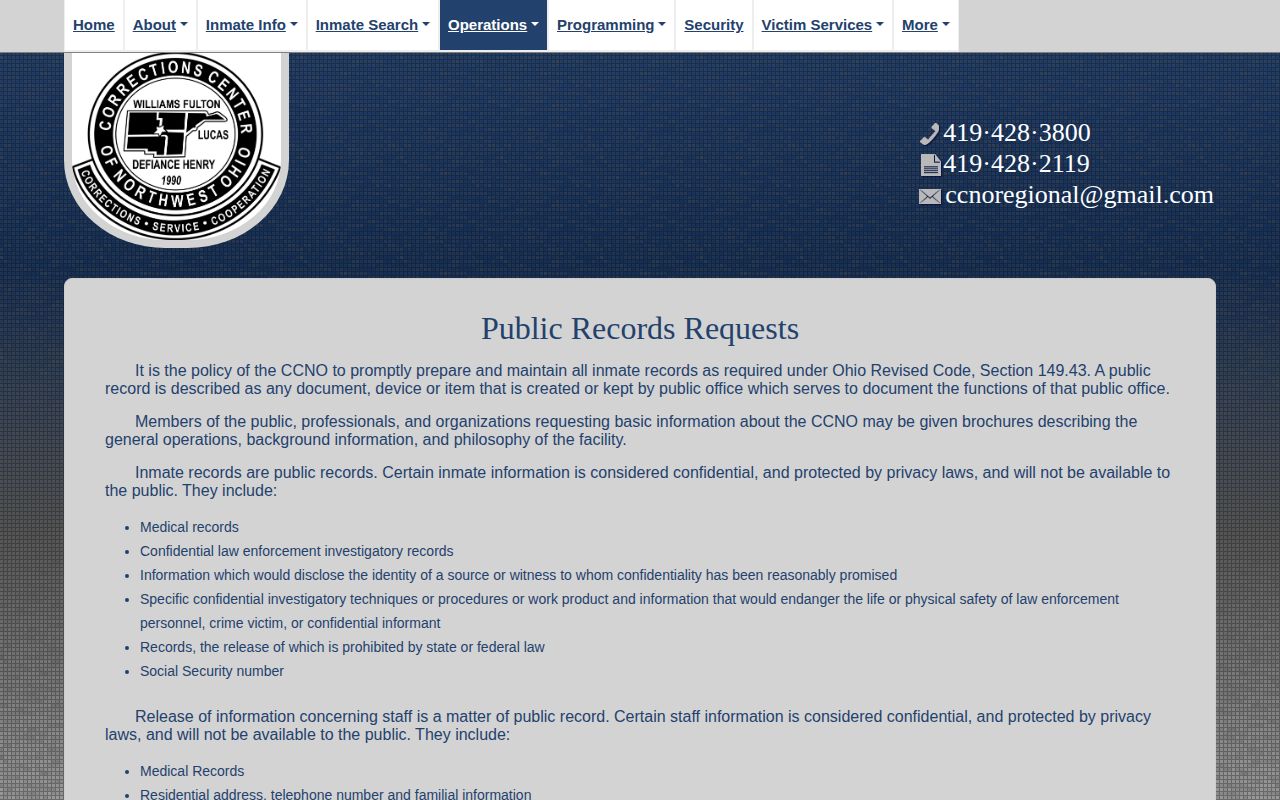
The page supports a direct, focused request even though CCNO publishes no searchable archive of released people.
If CCNO says the request is ambiguous or too broad, revise it around a single booking or closing transaction. Ohio public-record law allows an office to explain how its records are organized and help narrow the request. Inspection is generally free, and electronic delivery normally adds no material copy cost. No fixed number of response days was established, so “reasonable period” is the accurate timing statement. A Sheriff incident or local-holding question should go to the Defiance County Sheriff, while CCNO remains the first custodian for the regional-jail booking and its release or transfer entry.
Ohio Law and Defiance Release Records
Ohio Revised Code 149.43 governs access to public records, and CCNO says inmate records are public subject to exceptions. Medical material, confidential investigative records and techniques, protected source or witness identities, Social Security numbers, safety-sensitive information, and records barred by another law may be withheld or redacted. Juvenile and DYS material is outside this adult search path and is commonly confidential.
Sealing or expungement can restrict an official record. Ohio’s definitions treat arrest, complaint, indictment, court, and correctional material as official records. A non-result after sealing cannot prove that no event ever occurred. Timing may also turn on final discharge, not merely the day someone passed through the jail gate. For an ODRC case, release to APA supervision comes before any later certificate ending parole or post-release control.
No researched source gives a fixed destruction period for a CCNO booking or release record. The online Active Offenders PDF is current-only, while the previous-day and previous-seven-day reports preserve admissions only for their labeled windows. The underlying agency record follows the applicable retention schedule. That difference matters: the end of online visibility is not the destruction date, and neither one proves that a court record was sealed. Request the record from its custodian and let that office identify any lawful redaction or restriction.
How Fast Does CCNO Release People?
CCNO’s regional figures put roster change in context. The facility reported 4,602 bookings and 4,520 releases during 2025, with an average stay of 35.74 days. Those are totals for the full regional institution and its contract populations. They are not Defiance County-only counts and should never be presented that way.
The CCNO facility statistics page supplies the regional totals.
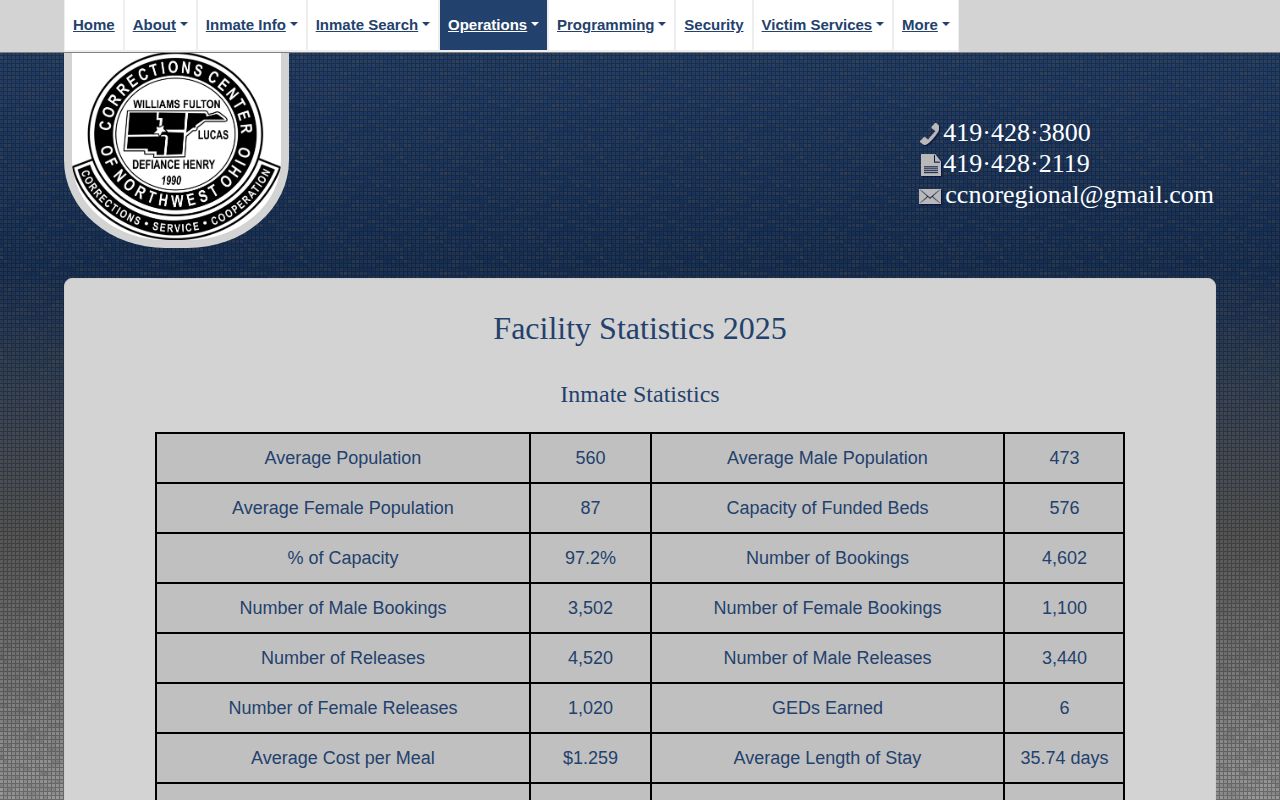
Rapid turnover explains why a current list can change quickly, but it does not turn a missing entry into a confirmed release.
Search for a Released Defiance County Inmate
The strongest search is a chain of official sources, ordered by the custody that may have ended. Record the time of each lookup because CCNO, ODRC, VINE, BOP, and ICE displays can change. Match at least two stable identifiers, such as a booking or offender number, birth date, docket, court, or committing agency.
When the sources disagree, compare the event each one records rather than selecting the most convenient result. A signed court order can authorize bond or dismissal before CCNO finishes processing. A VINE alert can report a custody change before a durable record arrives. ODRC can take time to show reception after a state-prison transport, and a federal detainee may remain under USMS control without a BOP result. The defensible answer names the source, the event, and the access time, then leaves broader custody questions open until the receiving agency is known.
- Open CCNO Active Offenders. This tests current regional-jail listing only.
- Use the previous-day or previous-seven-day booking report only to recover a recent booking number, agency, court, or image. Neither report is a release list.
- Search Defiance Municipal Court for misdemeanor, traffic, and felony preliminary activity, and Common Pleas CourtView for felony and Common Pleas proceedings.
- Check the named person in Ohio VINE or call CCNO at 419-428-3800 for immediate custody status.
- Request the CCNO closing entry for lasting proof of the date, time, disposition, and destination.
- If the result shows prison or federal transfer, switch to ODRC or the controlling federal agency rather than calling it a community release.
A name dropping off Active Offenders is a clue to investigate. It does not distinguish release, court movement, transfer, escape, or death.
ODRC Search for Defiance County Prison Releases
The Ohio Department of Rehabilitation and Correction Offender Search covers people incarcerated in Ohio prisons, under Department supervision, or judicially released. Search by first and last name or a six-digit ODRC number without spaces or hyphens. A last-name search can return names beginning with the entered text, so confirm identity against the number, date of birth, offenses, docket, and committing county.
| ODRC field | How to read it after prison |
|---|---|
| Status | APA SUPERVISION confirms release from incarceration into Department supervision; JUDICIAL RELEASE identifies a court-authorized path. |
| Expected Release Date/Parole Eligibility Date | A forecast or eligibility date, not proof that release happened. |
| Supervision Start Date | With a released status, supports the transition out of prison. |
| Parole or Release Detail | Can show release information after release and may be blank while incarcerated. |
| APA office and residential county | Identifies the supervision geography, which can differ from the committing county. |
| Hearing or review fields | Show board process, not necessarily an actual gate date. |
The ODRC search screen shows name, number, status, county, and hearing-month controls.
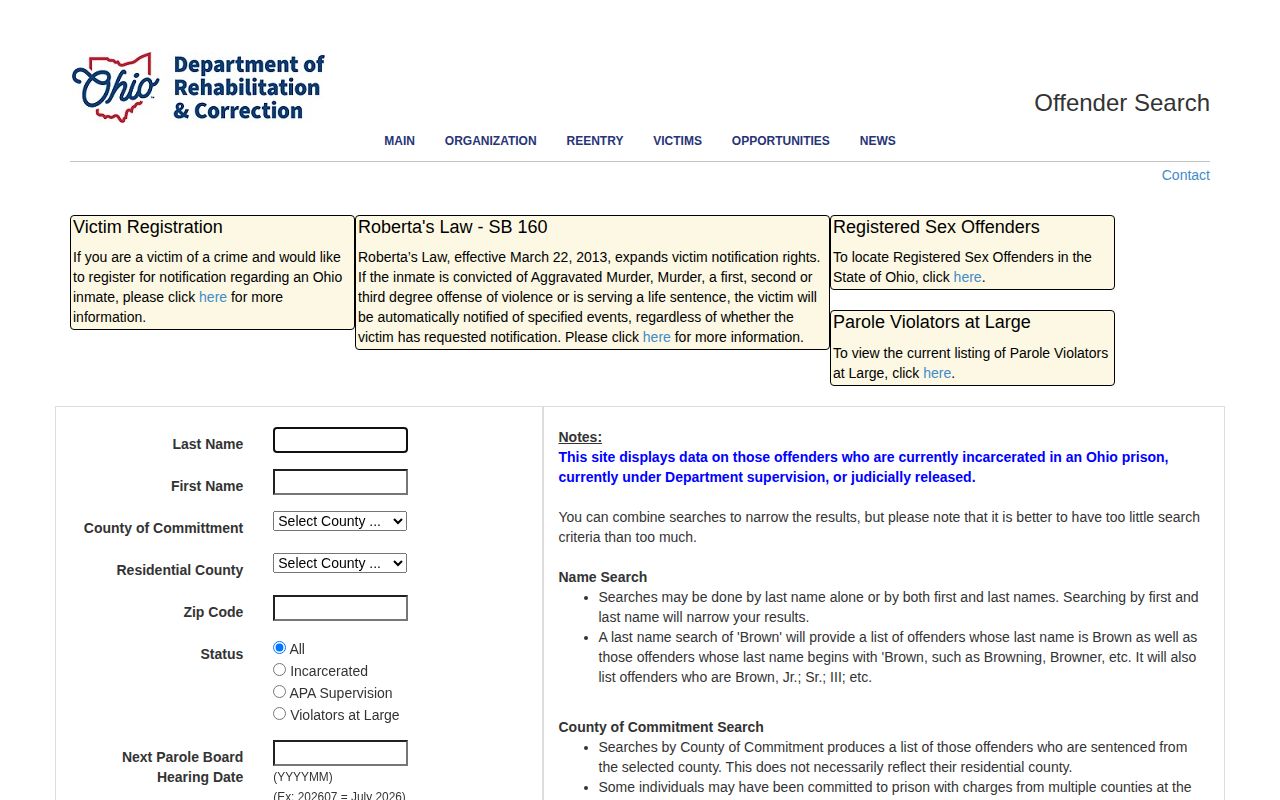
For a fully discharged person outside online scope, write ODRC Central Records, P.O. Box 430, Columbus, OH 43216, for releasable discharge facts and public decisions.
Why Defiance Custody Has Two Locations
Longer local confinement occurs at CCNO in rural Stryker, while Sheriff Court Security maintains a short-term holding point at 113 Biede Avenue in Defiance. Adults may arrive there from CCNO while proceedings are pending, appear in Municipal or Common Pleas Court, and return to CCNO the same day. Court Security also handles court-sentenced prisoners, APA arrests, extraditions, and state-institution transport.
The Sheriff’s Court Security page describes the local holding and movement role.
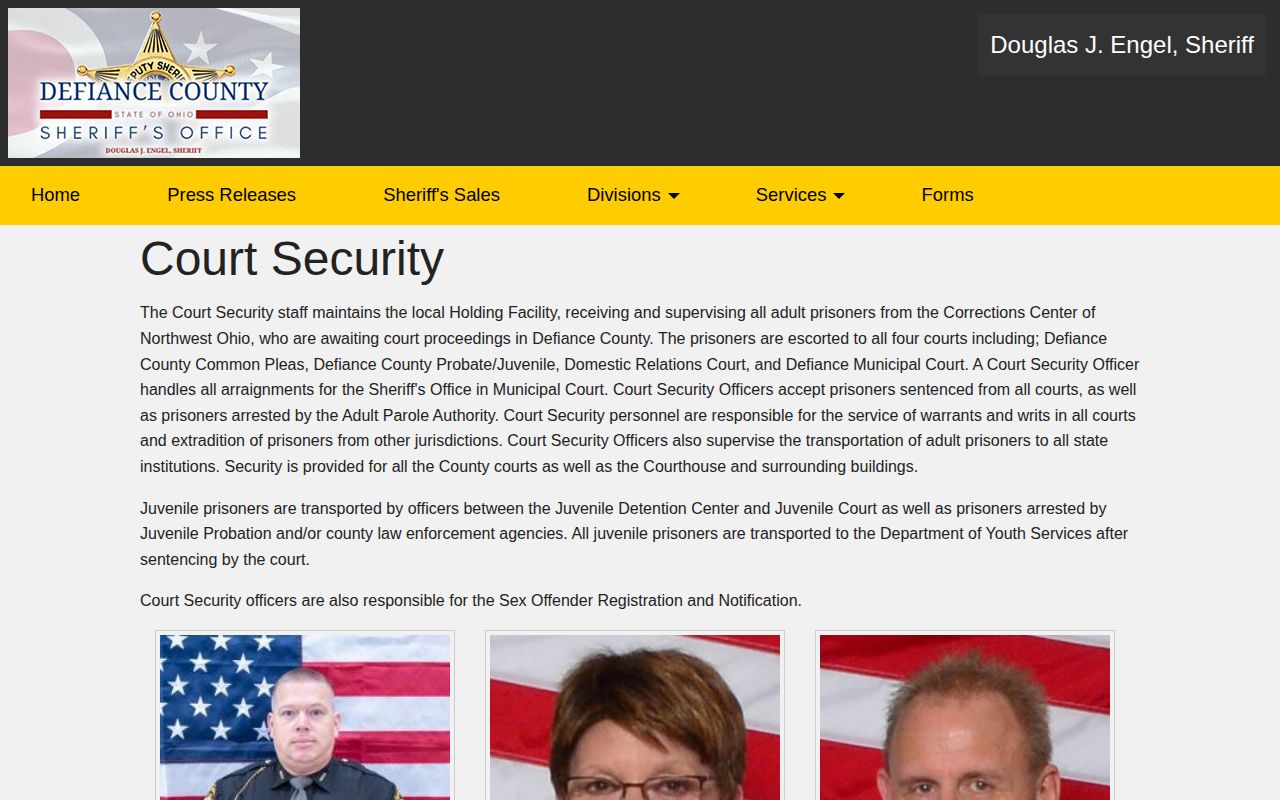
This two-location geography is why absence from 113 Biede Avenue cannot substitute for a CCNO release or transfer record.
Defiance Releases to Community Corrections
CCNO’s local alternatives include court-assigned electronic monitoring and work release. These are structured placements, not unconditional discharge. Published program details say work-release participants provide their own transportation and pay 25 percent of net pay toward jail and court costs. Electronic-monitoring participants pay unless a court finds them indigent.
These terms are specific to the community-corrections programs. They do not establish a general fee or transportation rule for everyone released from CCNO. No official fixed gate time, weekend schedule, exit door, waiting zone, supplied ride, or public-transit stop was found. For day-specific instructions, call CCNO rather than infer them from a program rule.
What Happens to Property on an ODRC Transfer?
CCNO’s state-prison transfer rules are unusually detailed and apply when custody continues into ODRC. Property and money do not travel with the person. A sentenced person should authorize immediate release of property and funds to family or a friend. Remaining property may be held for pickup and disposed of after 60 days. Funds may be mailed to the receiving ODRC institution; a returned check that cannot be forwarded is held for two years under CCNO policy. Prescription medicine left behind is held for 30 days before destruction.
The CCNO prison-transfer page names the CRC and ORW destinations and explains these property rules.
These deadlines are evidence of a continuing prison transfer process, not rules for an ordinary community discharge.
Defiance Release Alerts and Supervision Checks
Ohio VINE covers county jails and ODRC custody events. Search one person at VINELink or call 1-800-770-0192. County-jail event types include general release, transfer, escape, and death, which is more precise than an unexplained roster disappearance. A missing result alone remains weak evidence because the system does not promise a permanent released-person result.
After an Ohio prison release, ODRC may show APA SUPERVISION, the start date, period, office, and residential county or ZIP. Defiance Adult Probation at 500 Court Street, Suite G, supervises local community control but offers no public person search. State parole or post-release control and local probation are distinct. The detailed Defiance County parole and probation guide explains how to verify each without treating a warrant flag as custody proof.
Federal Releases from CCNO
CCNO holds people under a U.S. Marshals Service agreement alongside local detainees. A federal pretrial detainee may never appear in the BOP locator because USMS, not BOP, controls that stage. If the name disappears, check the federal court order and contact the U.S. Marshals Service. BOP becomes useful after delivery to BOP or for a post-1982 BOP record. A BOP “Released” result proves departure from BOP custody, not the end of supervised release or another government hold.
ICE uses a separate Online Detainee Locator System. Its released-from-ICE scope may retain some records for only 60 days, and a result does not distinguish community release from removal, transfer, or other control. If a CCNO record shows a federal or immigration receiving authority, follow that named authority. Do not infer a destination from a blank federal search.
Where Defiance Released Inmates Appear
Use each system only for the question it can answer. The comparison prevents a current-custody tool from being mistaken for a released-person archive.
| Source | Custody question | Released-person value |
|---|---|---|
| CCNO Active Offenders | Is the person currently listed at CCNO? | Absence is not release proof. |
| CCNO release/transfer record | How and when did this booking close? | Best local record for time, disposition, and destination. |
| Defiance court docket | What legal order affected custody? | Shows bond, dismissal, sentence, community control, or later orders. |
| ODRC Offender Search | Did Ohio prison custody continue or change to supervision? | Released statuses and supervision dates may remain searchable. |
| VINELink | Did a registered custody event occur? | General-release or transfer alert can supply prompt notice. |
| Federal docket, USMS, BOP, or ICE | Which federal agency controlled the person? | Coverage and meaning depend on that agency and stage. |
Defiance County Release Facilities
The local path spans five custody points. The Corrections Center of Northwest Ohio is the primary regional jail. The Defiance County Sheriff local Holding Facility is a short-term court and transport point. Most men sentenced to Ohio prison move through the Correctional Reception Center, while women move through the Ohio Reformatory for Women. CCNO federal contract custody follows USMS and, when applicable, BOP records.