
Defiance Parole Versus Probation
Parole, post-release control, judicial release, and probation are not interchangeable. Ohio Adult Parole Authority supervision follows release from state incarceration when the sentence or release order calls for it. The ODRC Offender Search can display that state link. Defiance County Adult Probation instead supervises community control ordered by a local court. Ohio often uses “community control” for what readers call probation. A person can leave CCNO under a local court order without ever entering ODRC custody.
The source should match the sentence. A Defiance conviction does not prove that a person reports to a Defiance APA unit, because ODRC may assign supervision by residence and the person-specific record. Likewise, the county probation office cannot confirm state parole. The comparison below separates the two common paths.
| Question | State parole or control | County probation |
|---|---|---|
| Who orders it? | Statute, ODRC, Parole Board, or sentencing court after prison | Defiance court as community control |
| Who supervises? | Ohio Adult Parole Authority | Defiance County Adult Probation |
| Public person search? | ODRC search while the record remains in scope | No public county probationer search was found |
| Best proof | Status, supervision start, term, office, and release decision | Court order plus confirmation from the probation office |
A release from CCNO to electronic monitoring or work release also differs from an unconditional discharge. Those court-assigned placements retain rules and oversight even when the person is outside a secure jail unit.
- Parole
- Conditional release under state authority before a parole-eligible sentence fully ends.
- Post-release control
- A period of Adult Parole Authority supervision after eligible Ohio prison terms.
- Probation or community control
- A court-ordered sanction served in the community under local supervision.
- Discharge
- The formal end of custody or supervision, not merely the day a jail or prison gate opens.
Verify Defiance Post-Release Supervision
Begin with the custody history, not a guess about the office. For a person who went from CCNO to the Correctional Reception Center or Ohio Reformatory for Women, ODRC is the right first source. For community control imposed by Defiance Municipal Court or Common Pleas Court, use the court docket and Defiance County Adult Probation. A name missing from CCNO’s Active Offenders PDF says only that active CCNO listing ended.
- Search ODRC by full name or the six-digit offender number. Match the date of birth, docket, offense, and committing county before relying on a result.
- Read Status first.
APA SUPERVISIONconfirms release from incarceration under Department supervision.JUDICIAL RELEASEidentifies a court-authorized prison exit. - Compare Supervision Start Date, Period of Supervision, APA Offices, residential county or ZIP, and any end or early-termination field.
- For local probation, review the controlling Defiance court entry for community control, later modifications, or termination. Then contact Adult Probation for proper routing.
- If the person no longer appears after all state supervision ended, request the releasable discharge facts and public APA or Parole Board decision from ODRC Central Records.
The Defiance County released inmate search paths explain how CCNO, courts, ODRC, and VINE fit together when the starting custody is not clear. Keep a note of when each live search was checked because official fields can change.
Important: A future Expected Release Date/Parole Eligibility Date does not prove that release occurred. Released state status and a supervision start date are stronger evidence.
Defiance Probation Office and APA
Defiance County Adult Probation handles court community control, presentence work, intervention in lieu, and several specialized local caseloads. Its official page does not provide a public person search or an absconder list. Office staff can route local supervision questions, but they do not replace ODRC for a person released from Ohio prison.
Defiance County Adult Probation
500 Court Street, Suite G
Defiance, OH 43512
Phone: 419-782-6569
Fax: 419-782-6734
Hours: Monday through Friday, 8:30 a.m. to 4:30 p.m.
The official Adult Probation page shows the office scope, contact details, and hours. The source image below preserves that local routing context.
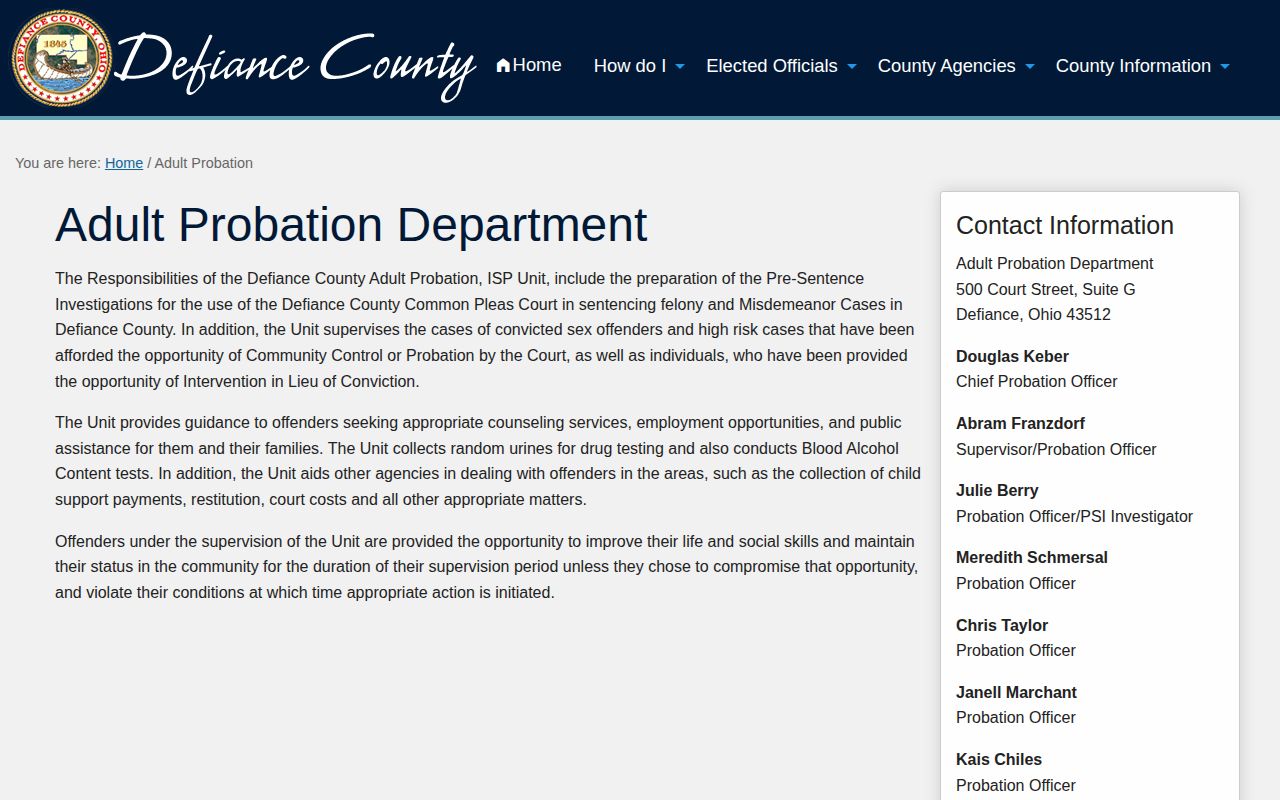
The office details confirm local community-control coverage, while state parole and post-release control remain with the assigned APA unit shown in ODRC.
Live ODRC records researched for Defiance residents displayed unit labels such as DEFIANCE 1 and DEFIANCE 2. Those labels are routing clues only. They do not establish a public office address, reporting time, or individual instructions. The supervised person should follow the paperwork supplied by the assigned authority.
Defiance Supervision Conditions and Discharge
State conditions apply at a high level, while special terms may be person-specific. ODRC’s statewide Conditions of Supervision addresses reporting, conduct, travel, searches authorized by law, and a monthly supervision fee unless waived. A court or parole authority may impose added conditions. The public search is not the full supervision order, so the displayed status cannot answer every compliance question.
Local community control likewise follows the sentencing entry and later court orders. A violation may lead to a hearing, changed sanctions, a warrant, or custody, but an allegation is not the same as a final court or agency decision. Defiance Municipal and Common Pleas dockets are the appropriate places to look for local judicial action.
Supervision ends through an official act. Under ORC 2967.16, Ohio may issue a certificate of final release from parole or a certificate terminating post-release control once the governing conditions are met. That date is distinct from the earlier prison release date. A narrow records request may be needed after the person leaves the online search scope.
Note: Final discharge can matter to later court-record processes, so preserve the exact certificate or termination date when it is available.
Defiance Release Alerts and Supervision
Ohio VINE helps with custody events, but it is not a complete supervision file. CCNO participates in Ohio VINE, whose county-jail event labels include general release, transfer, escape, and death. Those labels are useful in Defiance because a person can disappear from the active regional-jail list after either community release or transfer. A registered alert can identify the reported event while the court and CCNO release record provide the lasting facts.
State-prison notifications can cover release, transfer, parole-related events, and release from parole. ODRC also operates a separate victim-notification account. Registration in VINELink does not automatically create that distinct ODRC account. Neither system replaces the person-specific state status, supervision start date, assigned APA office, or final discharge certificate.
The CCNO victim-notification page confirms local VINE participation and the Ohio toll-free route. For a direct person check and alert registration, use the Defiance VINELink inmate check. A missing result should lead back to CCNO, ODRC, or the court rather than a conclusion that all custody and supervision ended.
Defiance Supervision Violations and Warrants
No official Defiance County all-warrants or probation-absconder database was found. The Sheriff’s Court Security unit handles warrants, writs, extraditions, and APA arrests, but that role does not create a complete public name search. A warrant is also neither current jail proof nor release proof. The controlling court or law-enforcement agency must confirm it.
ODRC uses the public status APA SUPERVISION - VAL for a violator at large. VAL means ODRC reports the person as wanted for a supervision violation. It does not show that the person has already been arrested or placed in CCNO. ODRC directs the public not to attempt apprehension. Immediate safety concerns belong with 911 or local law enforcement.
The official ODRC VAL example shows how that warning and Defiance supervision unit appear in a live state record.
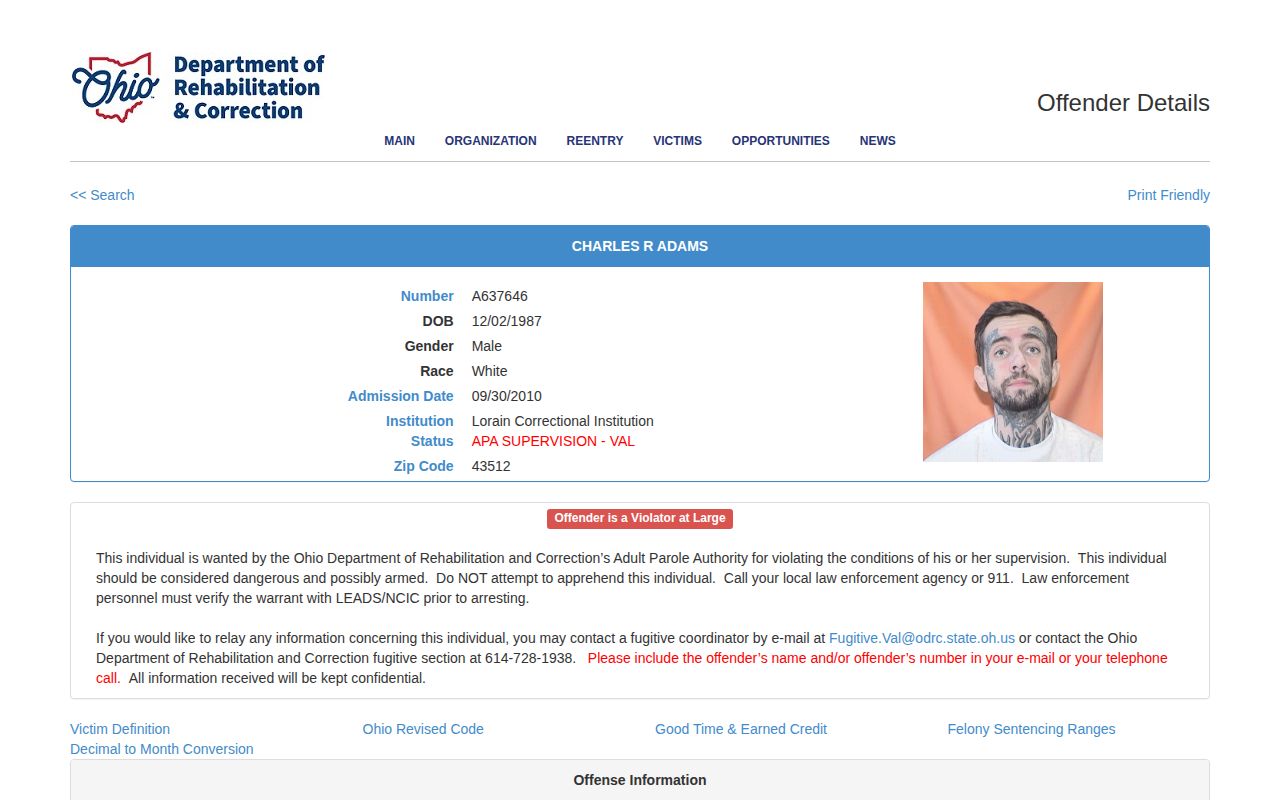
The state record demonstrates why status must be read literally: VAL reports supervision and warrant context, not present confinement at a named jail.
ODRC Fugitive Section
Phone: 614-728-1938
Email: Fugitive.Val@odrc.state.oh.us
Use: information about a displayed VAL status
Defiance Community Corrections Options
CCNO publishes two local alternatives that can look like release while still carrying court control. Work release lets a qualifying participant spend non-working hours in custody. The participant supplies transportation to and from work, and CCNO applies 25 percent of net pay toward jail and court costs. Court-assigned electronic monitoring or house arrest follows screening, uses an ankle monitor, and is paid by the participant unless the person is found indigent.
These arrangements should be described as community corrections, not as unconditional release. The underlying court order and CCNO program record define the placement. CCNO lists 419-428-3800 extension 405 for Community Corrections and extension 447 for electronic monitoring, GPS, and TAD matters. Published monitoring placements range from 15 days to six months, but an individual term comes from the actual order.
A person who goes from a cell to electronic monitoring may vanish from an active unit list while remaining under close controls. Verify the event with the court and CCNO rather than assuming that roster absence ended the sentence.
Property After Defiance Prison Transfer
CCNO’s prison-transfer rules create a separate post-custody task for families. Money and property do not travel with a person sent from CCNO to ODRC. The sentenced person should authorize prompt release of funds and property to a family member or friend. Remaining property can be held for pickup and disposed of after 60 days. Prescription medicine left behind is held for 30 days before destruction.
Funds may be mailed to the receiving ODRC institution. If a returned check cannot be forwarded, CCNO policy allows it to be held for two years before later transfer under that policy. These time periods apply to state-prison transfers, not ordinary community discharges. The CCNO prison-transfer instructions should be checked before pickup or mailing because the receiving institution and timing matter.
This property process reinforces the custody distinction. Departure from CCNO for CRC or the Ohio Reformatory for Women continues confinement. ODRC, not a county probation office, becomes the correct source for later prison release and supervision.