
CCNO Release Paths
The Corrections Center of Northwest Ohio is the primary adult jail serving Defiance County, but it stands in Stryker in Williams County. The five-county Corrections Commission runs it for Defiance, Fulton, Henry, Lucas, and Williams counties, as well as contract populations. That regional structure determines where a record request goes. The Sheriff address in Defiance is not the records office for an ordinary CCNO booking. A person tied to a Defiance case can leave CCNO on bond, recognizance, time served, sentence completion, dismissal, or another court order. Those events can return the person to the community.
Other departures continue custody. A prison sentence usually sends a man to the Correctional Reception Center or a woman to the Ohio Reformatory for Women. A federal detainee may move under U.S. Marshals Service authority. CCNO can also transfer someone to another jail or place an eligible person in court-ordered electronic monitoring. The closing release or transfer disposition is therefore the key fact. It should name the event and, when recorded, the destination or receiving agency.
| CCNO departure | Best next source | What it means |
|---|---|---|
| Bond, recognizance, time served, dismissal | CCNO record and Defiance court docket | Potential community release |
| State prison sentence | ODRC Offender Search | Custody continues at reception |
| Federal movement | Federal court and USMS | May remain in federal custody |
| Electronic monitoring | CCNO Community Corrections and court order | Community placement with controls |
Note: A CCNO active-list disappearance starts the check; it never establishes the release reason by itself.
Confirm a CCNO Release
Begin with the CCNO Active Offenders page. It opens a current-custody PDF after a disclaimer. The agency warns that data changes fast and may contain errors. Presence supports current CCNO listing at the time checked. Absence has no single meaning. CCNO also publishes previous-day and previous-seven-day booking reports, but those reports show admissions, not releases. They can recover a booking number, agency, case, court, or photo. They cannot prove that someone went home.
A sound release check uses sources in order and records the time each was consulted. The Ohio VINE service can report a general release, transfer, escape, or death while its custody record is active. A Defiance Municipal or Common Pleas docket explains the legal authority. The CCNO closing record supplies the physical release time and disposition. If it identifies ODRC, USMS, or another jail, continue with that custodian instead of calling the event a community release.
- Check Active Offenders for current CCNO listing.
- Use a recent booking report only to collect stable identifiers.
- Check Ohio VINE or call CCNO for an immediate custody event.
- Read the Defiance court docket for bond, dismissal, sentence, or transfer authority.
- Request CCNO's release or transfer entry for durable proof.
Request CCNO Release Records
The CCNO public-records office accepts requests by email, mail, telephone, and in person. Ask for an existing releasable record rather than a custom explanation. Give the full name, approximate booking date, date of birth when lawfully known, booking number, and Defiance court case if available. Request admission date and time, arresting or committing agency, court and case number, status, release date and time, release disposition, receiving agency or destination, bond or time-served notation, and booking photograph. CCNO has not promised that every proposed field exists, so phrase the list as requested fields.
Ohio public-record law permits exemptions and redaction. Medical records, protected personal identifiers, confidential investigatory material, sources, techniques, and information that could endanger protected people may be withheld. A narrow request that permits lawful redaction is more precise than asking for the complete unedited file. The records page states that copies are produced at cost within a reasonable period, not a fixed deadline. Letter-size single-sided paper copies cost $0.25 each. Electronic delivery can be requested.
CCNO Public Records
03151 County Road 2425
Stryker, OH 43557
419-428-3800, ext. 201
ccnoregional@gmail.com
Monday through Friday, 8:00 a.m. to 4:00 p.m.
The official records page visually confirms the access channels and terms. Review the CCNO request instructions before submitting a request.
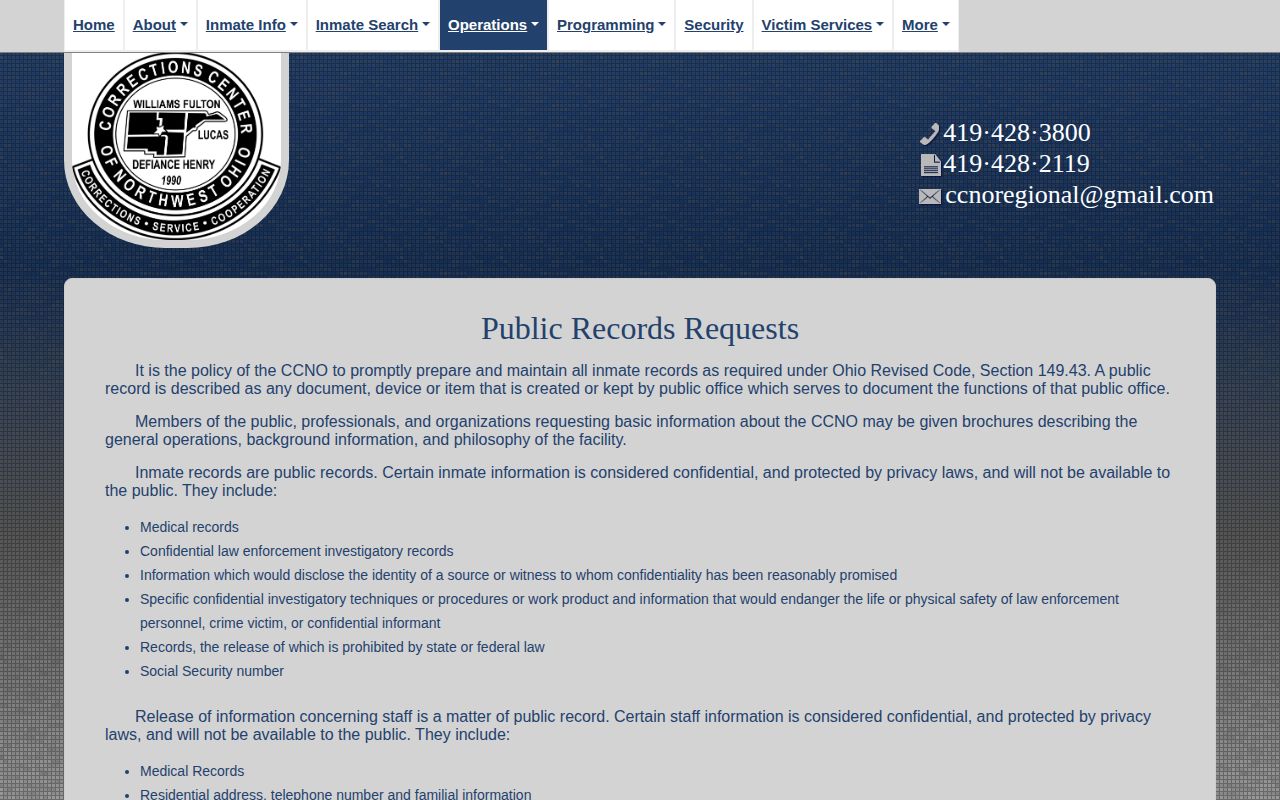
The capture helps identify the correct custodian and keeps the request tied to the regional-jail booking rather than the Sheriff’s short-term holding operation.
CCNO Release Statistics
CCNO reports regional totals, not Defiance-only release counts. Its 2025 facility statistics list 4,602 bookings and 4,520 releases, with a 35.74-day average stay. The average population was 560 against 576 funded beds. Male releases numbered 3,440 and female releases 1,020. A separate jurisdiction measure reported an average of 54 Defiance prisoners during that year, but it did not give the number of releases attributable to Defiance County. Keeping those measures apart prevents a regional total from being misreported as a county total.
The official CCNO statistics show how much movement occurs across the whole regional jail.
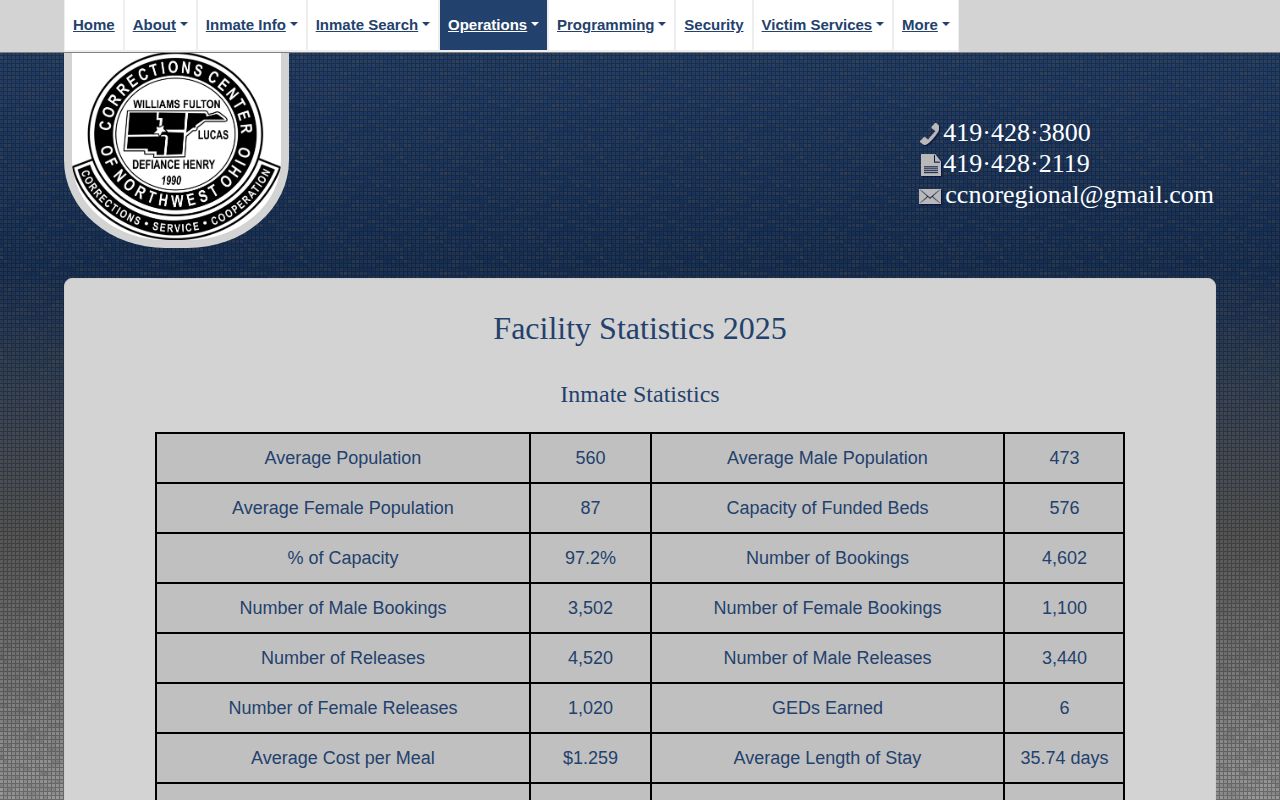
High turnover helps explain why a roster changes often, but aggregate counts cannot identify what happened to one named person.
CCNO Prison Transfer Records
CCNO publishes detailed rules for people sent to Ohio prison. Its prison-transfer information names CRC as the usual reception point for men and ORW for women from member Common Pleas courts. That trip is continuing state custody. After reception, the ODRC offender search becomes the current-location and later release-status source. The Defiance County search and release-record overview on the home page explains how to switch systems without confusing the jail exit with a prison discharge.
Property and money do not travel with the person to ODRC. CCNO advises a sentenced person to authorize release of property and money to family or a friend. Remaining property may be held for pickup and disposed of after 60 days. Funds can be mailed to the ODRC institution. A returned check that cannot be forwarded may remain held for two years under CCNO policy, while prescription medication left behind is held for 30 days before destruction. These rules apply to prison transfers, not ordinary community discharge.
- Release
- A closing custody event that may return a person to the community.
- Transfer
- A move from CCNO to another custodian, with custody continuing.
- Reception
- ODRC intake, assessment, and assignment after a state-prison sentence.
- Disposition
- The recorded reason and destination for closing or changing a booking.
Note: Ask CCNO for day-specific property instructions because the researched transfer rules do not establish a general community-release procedure.
CCNO Records Geography
The Corrections Commission formed in 1987, and CCNO says it has operated since 1990 as Ohio's first regional jail. Its annual reporting describes transport across Ohio and into Michigan and Indiana. That history explains why location alone is weak release evidence. A person may leave Stryker for a Defiance court trip, state reception, a contract transfer, or another jail. The active list cannot encode every destination in a missing name.
No official fixed release time, weekend or holiday schedule, exit door, family waiting area, supplied ride, or public-transit stop was found. CCNO's rural location makes those practical questions important, yet details must come from the facility for the day at issue. Call 419-428-3800 before arranging pickup. Work-release participants must provide their own transportation to work, but that program rule cannot be generalized to final discharge.
CCNO also operates court-assigned electronic monitoring and work release as community-corrections options. A participant may be outside the secure building for approved activity while still subject to a court order and program controls. Work-release participants spend non-working hours in custody, provide their own work transportation, and pay a stated share of net pay toward jail and court costs. Electronic monitoring uses an ankle monitor after screening and court assignment. Neither status should be described as an unconditional discharge. Confirm the exact order and program status with CCNO Community Corrections and the sentencing court.
For a Defiance arrest, match the CCNO booking to the Municipal or Common Pleas case. For a state transfer, use ODRC after reception. For federal contract custody, use the controlling federal agency. This source-by-source method produces a bounded statement about the recorded event and avoids treating absence as proof.