
CRC Transfer Is Not Release
CCNO’s official prison-transfer page says most men sentenced to Ohio prison by its member Common Pleas courts go to the Correctional Reception Center in Orient. A Defiance County defendant may therefore disappear from CCNO’s Active Offenders report and appear later in the statewide system. That gap is not proof of freedom. The court sentence, CCNO transfer record, and ODRC reception record describe one continuing custody chain.
CRC performs reception for the Ohio Department of Rehabilitation and Correction. Reception is the state intake stage after a prison commitment. ODRC may later assign the person to another institution, so CRC should not be assumed to remain the long-term location. For a Defiance case, match the name with the ODRC number, birth date, committing county, docket, offense, and sentence. These stable fields help distinguish a transfer delay from a bad name match.
| Event | Correct record | Meaning |
|---|---|---|
| Departure from CCNO for CRC | CCNO transfer entry and sentence | State custody continues |
| ODRC reception | ODRC Offender Search | Prison record becomes primary |
| APA supervision starts | ODRC status and start date | Released from prison under supervision |
| Final discharge | ODRC discharge record | Department supervision has ended |
Check CRC Release Status
Use the ODRC Offender Search by last and first name or the six-digit ODRC number. The interface also accepts status and county criteria. Last-name searches can match names that begin with the entered text, so a name alone is not enough. Open the person’s detail page and compare number, date of birth, Defiance committing county, docket, offense, and sentence before relying on the result.
Read Status before any date. INCARCERATED means the person remains in prison custody. APA SUPERVISION marks release from incarceration into Department supervision. JUDICIAL RELEASE reflects a release ordered by the sentencing court. APA SUPERVISION - VAL means a person is wanted for a supervision violation, not that the person is housed at CRC. The Parole or Release Detail area can hold release information after release and is blank while incarcerated.
- Search by ODRC number when it is known.
- Match the Defiance docket, committing county, and identity fields.
- Read the current Status field first.
- Compare Supervision Start Date with the expected-date field.
- Use Central Records if the fully discharged person no longer appears.
CRC Release Record Fields
The ODRC detail can show identity, photograph, ODRC number, admission, institution, offenses and statutes, sentence effective date, jail-time credit, sentence components, Defiance committing county, docket, felony degree, judge, and aggregate sentence. Released-first fields include Status, Expected Release Date/Parole Eligibility Date, Parole or Release Detail, Supervision Start Date, Period of Supervision, APA office, residential county and ZIP, supervision end or early termination when applicable, and hearing results.
Those fields answer different questions. The expected date is prospective or eligibility-oriented. A Supervision Start Date paired with APA SUPERVISION is stronger proof that incarceration ended and supervision began. Judicial release should be checked against the Defiance sentencing court’s entry. A person can be out of prison and still subject to parole, post-release control, or judicial-release supervision. Final discharge is a later event.
- Expected release date
- An ODRC projection that can change.
- Parole eligibility date
- The point at which a qualifying sentence may be considered, not a promise of release.
- Supervision start
- The date Department supervision began after prison release.
- Final discharge
- The later end of parole or post-release control after requirements are met.
Note: A reception institution shown on an older record may differ from the person’s current assigned prison.
Request CRC Discharge Records
ODRC’s public search is not a complete archive of every person ever discharged from Ohio prison. It covers people currently incarcerated, currently under Department supervision, or judicially released within the system’s stated scope. When a fully discharged person cannot be found, request an existing record from ODRC Central Records. Include full name, ODRC number, date of birth, Defiance committing county, and docket when available.
Ask narrowly for the date, cause, and terms of discharge, plus any public release order or Adult Parole Authority or Parole Board determination, order, or minutes. Ohio Revised Code 5120.21 requires the institutional record to include entrance or commitment and discharge facts. It does not make the whole institutional file public. ODRC confidentiality rules still apply, and the agency may redact or withhold protected material.
ODRC Central Records
Ohio Department of Rehabilitation and Correction
Attn: Central Records
P.O. Box 430
Columbus, OH 43216
No researched fixed per-page price or response deadline was established for this request. Ask for electronic copies and invite lawful redaction rather than demanding a complete unedited file.
CRC Sentence Release Changes
A projected prison release can change. Jail-time credit, earned credit, disciplinary action, court action, board action, indefinite-sentence review, or a data update may move the displayed date. Ohio’s current earned-credit law permits eligible people to earn credit for specified productive participation and completions, with statutory exclusions and caps. The often repeated claim that every Ohio prisoner serves exactly 85 percent is inaccurate. Mandatory terms, excluded offenses, judicial release, parole-eligible sentences, indefinite terms, and court orders alter the calculation.
For qualifying non-life indefinite terms, Ohio law can presume release at the minimum expiration or presumptive earned early-release date, but ODRC may rebut that presumption through a statutory hearing and retain the person within the maximum term. This makes a projected date a planning field, not gate proof. Actual release should be confirmed through released status, Supervision Start Date, the court or board action, and, when needed, the formal discharge record.
The Defiance County projected release date page addresses those computation rules in detail. For CRC, the central point is simpler: reception starts prison custody, institution assignment can change, and the statewide ODRC record controls later prison release evidence.
CRC Property Transfer Rules
CCNO’s transfer instructions state that property and money do not travel with a person to ODRC. Before transport, a sentenced person should authorize prompt release of property and funds to family or a friend. Remaining property may be held for pickup and disposed of after 60 days. Funds can be mailed to the ODRC institution after the destination is known. A check returned to CCNO that cannot be forwarded may be held for two years under the stated policy, and prescription medication left behind is held for 30 days before destruction.
The official transfer page was captured because it names both CRC and ORW and explains this unusual handoff. Review the CCNO destination and property rules before arranging pickup.
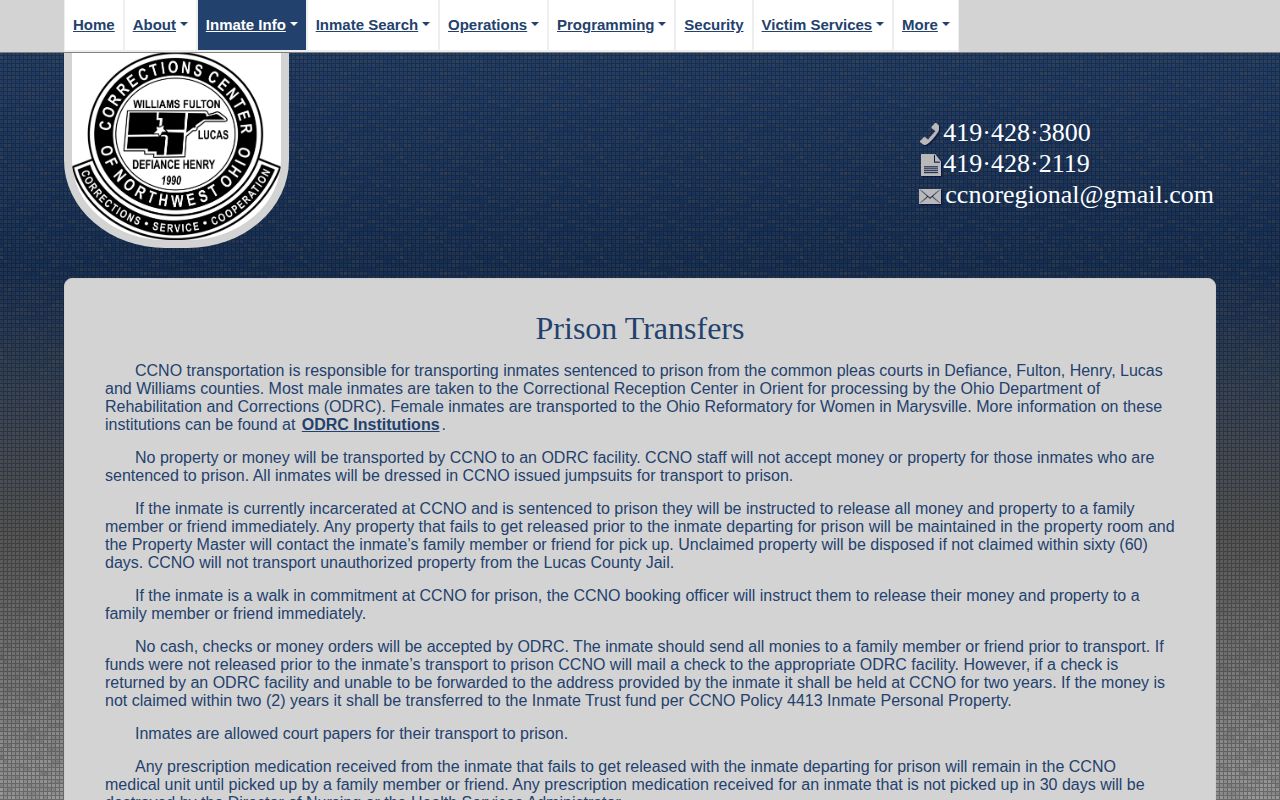
The image supports a transfer-specific procedure. It should not be used to infer how property is handled after an ordinary community release from CCNO or a later prison discharge from CRC.
CRC Defiance Record Chain
A clear record chain begins with the Defiance judgment and CCNO departure. It continues with ODRC reception, any later institution assignment, the current sentence record, and the eventual release-to-supervision or discharge event. Save the ODRC number and docket. Note the access time for every live search because status can change.
If the record says incarcerated, do not use the old CCNO absence as proof of release. If it says APA supervision, distinguish prison release from final discharge. If it says judicial release, inspect the Defiance court order. When the person is no longer in the public search, Central Records is the durable fallback. Each statement should name the source and scope rather than claim more than the record proves.