
CCNO Federal Release Paths
The Corrections Center of Northwest Ohio reports federal contract beds and a federal population housed at the same regional jail used by Defiance County. Many federal defendants are held under U.S. Marshals Service authority before trial, during court proceedings, or until delivery to a federal prison. CCNO supplies the physical bed. The federal agency and court control the legal custody path.
A departure can have several meanings. A judge may order release. USMS may move the person to another contract jail, a court location, or the Bureau of Prisons. A sentence may lead to BOP custody. A separate immigration issue may lead to ICE control. The CCNO closing entry should be requested for the destination or receiving authority, while the federal docket explains the court’s order.
| Federal event | Primary source | What absence may mean |
|---|---|---|
| Pretrial USMS custody | Federal docket and USMS | Transfer or court release |
| Federal prison custody | BOP Inmate Locator | In transit, confined, or released from BOP |
| ICE custody | ICE ODLS and DRIL | Detained, transferred, removed, or released from ICE |
| CCNO bed movement | CCNO transfer record | Receiving agency should be identified |
Confirm CCNO Federal Release
Start with the booking and federal case. Check CCNO’s active list only to see whether the person is currently listed at the regional jail. Its absence gives no federal disposition. Read the federal docket for a detention, release, dismissal, sentencing, or commitment order. Contact USMS when it controlled the person. The USMS prisoner operations information explains its role from court-ordered custody through acquittal or delivery to BOP.
USMS has no public retrospective name locator comparable to BOP. It may verify whether someone is in its custody but restrict location, schedule, and transport detail. For an existing federal prisoner record, use the USMS FOIA route when appropriate. Then ask CCNO for its releasable transfer entry, including the time, disposition, and receiving authority.
- Match the CCNO booking to the federal case and identifiers.
- Read the latest federal detention, release, or sentencing order.
- Ask USMS whether it still controls custody.
- Use BOP only after delivery to BOP or for its historical release record.
- Request CCNO’s destination field to resolve the local handoff.
BOP Release Records from CCNO
The BOP Inmate Locator covers federal inmates released after 1982. Search by BOP register, DCDC, FBI, or INS number, or use exact name with available age, race, and sex filters. Results can show name, register number, age, race, sex, release date, and location. A past date with no BOP facility, or a Released result, means the person is no longer in BOP custody. It does not prove the end of supervised release or rule out state, local, or immigration custody.
“Not in BOP Custody” also needs context. BOP data can include people held before trial, material witnesses, or people held for civil contempt. An In Transit result can reflect USMS movement. Release dates may be projected and can lag while sentence credits are recalculated. BOP states that locator data updates daily. Pre-1982 records require the National Archives route described by BOP.
The official locator capture shows both identifier and name search paths. Open the BOP federal release lookup before reading the example layout.
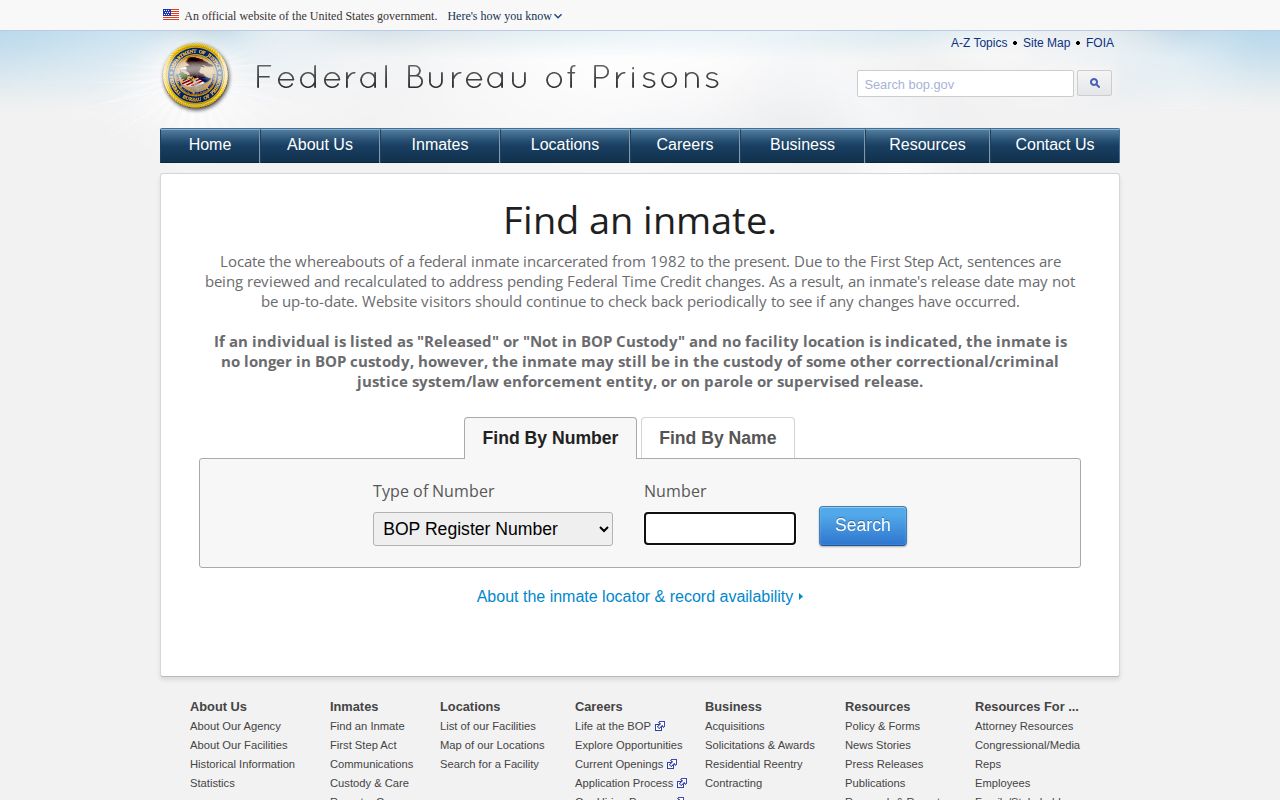
The image supports a BOP-specific check. It does not turn the locator into a source for ordinary CCNO county-jail releases.
CCNO Federal Record Request
CCNO’s public-records office can address the local booking and transfer transaction. Ask for the releasable record showing booking number, admission time, agency, court and case, status, release or transfer time, disposition, and destination or receiving authority. Include the approximate date and federal identifiers. The response may be redacted under state or federal law, and CCNO cannot create a federal court explanation that it does not maintain.
Requests go by email to ccnoregional@gmail.com, by mail or in person at the Stryker address, or by telephone at 419-428-3800 ext. 201. The public-records office lists weekday hours from 8:00 a.m. to 4:00 p.m. and $0.25 for a single-sided letter-size paper copy. It promises production within a reasonable period rather than a fixed number of days.
CCNO Federal Booking Records
03151 County Road 2425
Stryker, OH 43557
419-428-3800, ext. 201
ccnoregional@gmail.com
Monday through Friday, 8:00 a.m. to 4:00 p.m.
For the court order, use the federal court record. For continuing USMS control, contact USMS. For a BOP sentence or BOP release, use BOP. The Defiance County release-record search overview helps distinguish these federal channels from the county and state systems.
ICE Release After CCNO
The ICE Online Detainee Locator System searches with an exact nine-digit A-number and country of birth, or exact first and last name with country and optional birth date. It excludes people under 18. ICE says ODLS includes current detainees and some people released from ICE custody within the prior 60 days. Safety limits, exclusions, and data lag mean that not every person appears.
“Released from ICE custody” has a narrow agency meaning. It can accompany community release, transfer, removal, or another change in control. It should not be converted into a claim that the person remained in Defiance County or left all custody. A non-result after the 60-day window proves little. ICE’s Detention Reporting and Information Line is 1-888-351-4024, Monday through Friday except holidays, 8:00 a.m. to 8:00 p.m. Eastern.
- Detainer
- A request or notice involving another agency’s custody interest; it is not itself proof of current location.
- Removal
- An immigration outcome distinct from release into the local community.
- Supervised release
- Federal court supervision after imprisonment, separate from BOP physical custody.
- Receiving authority
- The agency taking custody after CCNO records a transfer.
Note: BOP and ICE locators cover different systems; neither replaces the federal docket or the CCNO transfer entry.
USMS and ICE Release Gaps
CCNO’s federal contract creates a distinctive Defiance-area problem. A federal detainee can appear in the same building as a county prisoner but follow a wholly different release chain. The person may be under USMS control without a BOP sentence. A disappearance from CCNO can therefore be a transfer that never produces an immediate BOP result. The federal court and USMS must bridge that gap.
ICE adds a second short-lived path. ODLS retains some released-from-ICE-custody records for only 60 days. Even within that period, the word released refers only to ICE custody and may mask removal, transfer, or another sovereign’s hold. Neither a missing USMS public locator, because none exists, nor a missing ICE result proves community release.
This is why the CCNO destination field matters. Ask whether the receiving authority was USMS, BOP, ICE, another jail, or no custodian. Then verify the named agency’s record. This facility-specific federal and immigration overlap is the strongest safeguard against reading a roster disappearance as freedom.
Read Federal Release Results
Use affirmative, scoped wording. A court order can establish release under stated conditions. A CCNO transfer record can identify the agency that took control. USMS can confirm its present custody within disclosure limits. A BOP Released result establishes departure from BOP custody, while an ICE released result establishes departure from ICE custody within that locator’s limited window.
Save register numbers, A-numbers, federal case numbers, booking numbers, and lookup times. Do not match by name alone. If two sources conflict, compare dates and ask about an in-transit period or same-day agency handoff. The final conclusion should state exactly which custody ended and which source recorded it.