
Defiance Holding Release Paths
The Defiance County Sheriff Court Security unit operates the local Holding Facility at 113 Biede Avenue. Official material describes a custody waypoint for court work, not a conventional long-term county jail. Court Security receives adults from CCNO while proceedings are pending, escorts prisoners to Common Pleas, Municipal, Domestic Relations, and other courts, and can accept people after a sentence or an Adult Parole Authority arrest. It also handles warrants, writs, extraditions, and transport to state institutions.
Those duties create several possible exits. A CCNO detainee may return to Stryker after court. A sentenced person may travel to state reception. An extradited person may pass to another jurisdiction. Someone may be released under a judge’s order, but the physical holding area does not publish an online archive that proves that event. Absence from 113 Biede Avenue has almost no value without the next record in the chain.
| Movement | Controlling source | Release meaning |
|---|---|---|
| Court trip from CCNO | CCNO and court docket | Usually temporary movement |
| State sentence transport | Court order, then ODRC | Continued prison custody |
| Extradition or warrant | Sheriff and receiving agency | Custody may continue |
| Court-authorized exit | Journal entry and controlling custodian | May be community release |
Confirm Defiance Holding Release
Start with the case. The Municipal Court record search covers misdemeanors, traffic matters, and felony preliminary activity. The Common Pleas CourtView system covers felony and Common Pleas proceedings. A felony can begin in Municipal Court and continue after indictment in Common Pleas, so search both when the route is unclear. Look for bond, recognizance, dismissal, sentence, jail-time credit, community control, or a later order. A court entry explains legal authority, though it may not show the minute physical processing ended.
Next identify the custodian. If the person came from CCNO and returned there, check the CCNO Active Offenders page and contact the regional jail. If a prison sentence led to transport, search ODRC after reception. If Court Security acted on an APA warrant, ODRC may show an APA supervision or violator-at-large status, but that label is not proof of current local confinement. The broad Defiance County release search explains how court, VINE, CCNO, and ODRC evidence fit together.
- Search the likely Defiance court by name and case number.
- Read the newest journal entries for the legal order.
- Call the Sheriff to clarify the local holding movement.
- Check CCNO, ODRC, or the receiving county named in the record.
- Request the closing record from the agency that controlled the booking.
Defiance Holding Record Custody
The Sheriff is the right contact for a local arrest or incident record and for clarification of Court Security’s handling. No dedicated online holding-facility release form, fixed response time, separate record hours, or facility fee schedule was found. A request should identify the person, date, court, case number, arresting agency, and the precise movement being examined. Ask for the releasable record showing when the person entered and left local holding, under whose authority, and to what agency or destination the person was released or transferred.
If CCNO controlled the underlying regional-jail booking, send the release or transfer request to CCNO instead. Its public-records office accepts email, mail, phone, and weekday in-person requests. That division matters. The Sheriff can explain a court-security event, while CCNO can provide the closing transaction for the regional confinement. A narrow request to each office may be needed when the record crosses both locations.
Defiance County Sheriff
113 Biede Ave.
Defiance, OH 43512
419-784-1155
Fax: 419-784-1592
dcsowebsite@defiancecounty.oh.gov
Note: No researched official source supports treating this address as Defiance County’s ordinary long-term searchable jail.
Defiance Court Transfer Evidence
Official Court Security material is unusually useful because it names the unit’s actual roles. View the Sheriff Court Security description before deciding which record should exist.
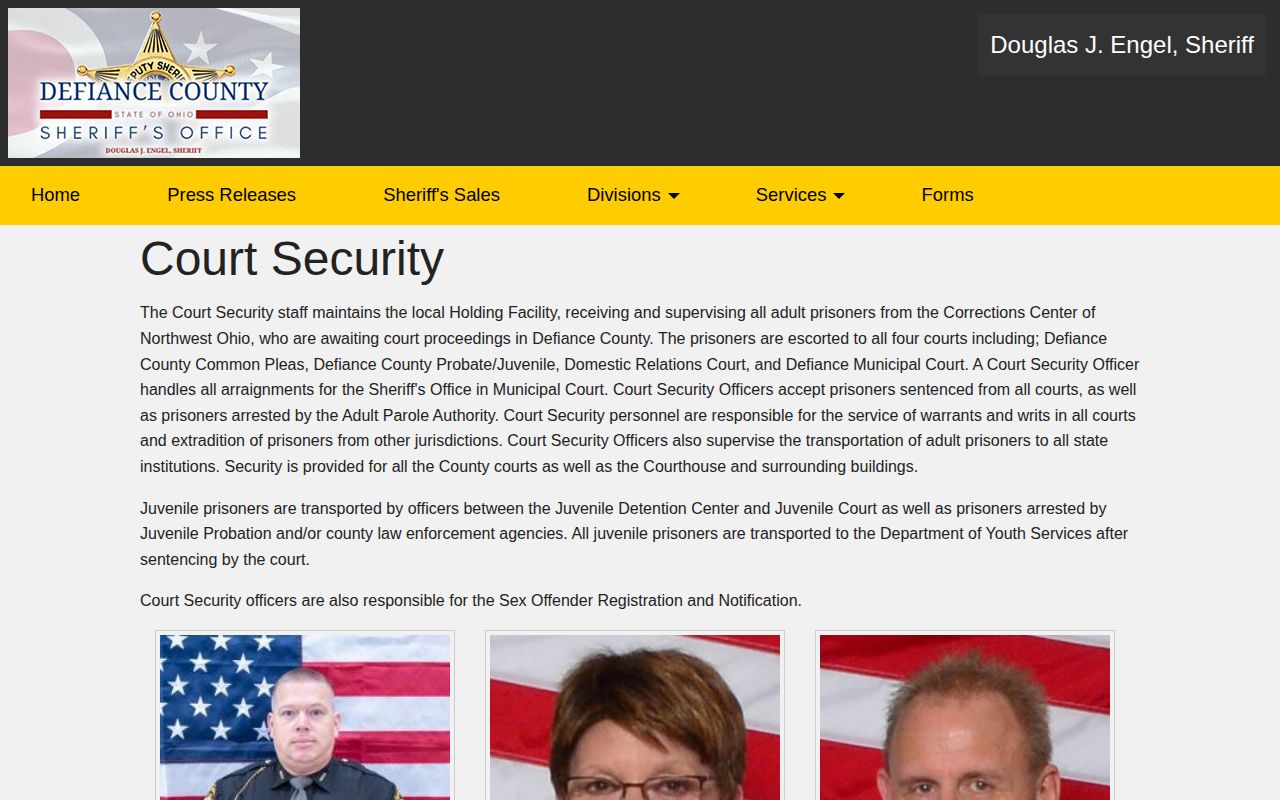
The capture shows why a court trip cannot be treated as a final release. It also supports routing state transports and APA arrests to the systems that control those cases.
A signed journal entry ranks highly for the legal reason. The Sheriff movement log can establish local handling. CCNO’s record is stronger for the regional-jail timestamp, while ODRC controls the state reception and later prison release record. When the records seem to conflict, compare their times and ask whether the person made a same-day trip between Defiance and Stryker.
- Holding facility
- A short-term secure place used while another process or movement is pending.
- Remand
- A court order returning or committing a person to custody.
- Extradition
- A formal transfer to another jurisdiction that seeks the person.
- Receiving agency
- The custodian that takes control after a transfer.
Defiance Holding Versus CCNO
Defiance County has a two-location custody geography. Long-term regional confinement occurs at CCNO in rural Stryker, outside the county. Temporary local holding supports proceedings in Defiance. A family member who saw someone near the courthouse may reasonably think the person was at a local jail, but the official record may show a court movement within a CCNO booking. The next stop determines the correct search.
CCNO publishes an active list, but no official 24-hour or 72-hour release feed. The local holding operation publishes neither a roster nor a release archive. For immediate facts, call the controlling agency and check VINE when applicable. For durable proof, join the court order with the jail release or transfer record. If the person was sentenced to prison, use ODRC only after reception. If a separate county or federal agency took custody, follow that agency’s record.
The key is modest wording. State that the Sheriff recorded a movement, the court ordered release, CCNO closed a booking, or ODRC received the person. Do not turn one fact into a claim that all custody ended. That approach respects the limits of each Defiance County source and gives a clearer answer.
Defiance Holding Contact Checks
No official fixed release time, waiting area, public-transit link, or general discharge door was found for this holding operation. Do not plan pickup from a generic web listing. Call the Sheriff at 419-784-1155 for the day-specific local process. If the person is actually at CCNO, call 419-428-3800 instead. For a court result, the Common Pleas Clerk is at 221 Clinton Street and the Municipal Court public terminal is at 665 Perry Street during its published weekday hours.
Keep the booking or case number ready. Names alone can match the wrong person, and a preliminary felony case may use a different docket after indictment. Note when each search was made because live custody displays change. The strongest conclusion names the agency, event, and time, such as a return to CCNO after court or a judge-authorized release, rather than merely reporting that a name was absent.
A VINE check can add an immediate custody event when the person remains within the participating county-jail system. General release, transfer, escape, and death are distinct event types. A missing VINE result does not prove release, and the service does not promise a lasting archive for a person who has already left custody. Use the alert as one timed piece of evidence, then preserve the court entry and the controlling agency’s record.
Records should also be separated by purpose. The Sheriff may hold the local movement or incident record. CCNO maintains the regional booking and its release or transfer disposition. The Clerk keeps journal entries. ODRC holds the state-prison record after reception. Asking one office for another agency’s record can yield a truthful non-result that still says nothing about the person’s status. Route each request to the office that created the event, and ask for the receiving authority whenever custody may have continued.
The same care applies after a hearing: confirm whether a new order took effect and which office now has authority before arranging travel or pickup.