
Defiance Projected Versus Actual Release
Ohio’s public label is Expected Release Date/Parole Eligibility Date. The slash is important. Depending on the sentence, the field can be a projected release date or a date when parole consideration becomes possible. It is not a universal promise that a person will walk out on that date. ODRC may later apply credit, discipline, board action, court action, or an indefinite-sentence review.
A Defiance detainee awaiting trial at the Corrections Center of Northwest Ohio usually has no computed release date. The next custody event may depend on bond, recognizance, dismissal, a plea, sentencing, or another court order. Even a signed release order does not state the exact hour when CCNO will finish processing. A sentenced jail term is more definite, but documented jail credit, sentence structure, and lawful reduction still matter.
Important: A scheduled or expected date is a forecast. Actual prison release is better confirmed by released status with a Supervision Start Date, while actual CCNO release is confirmed by the jail’s closing record.
Transfer must remain separate from release. A Defiance person sent from CCNO to the Correctional Reception Center or Ohio Reformatory for Women has changed custodians, not entered the community. ODRC becomes the source after reception.
Find Defiance Projected Release Dates
Use the source tied to the sentence. CCNO’s Active Offenders PDF cannot compute an Ohio prison term, and ODRC does not set a pretrial release date for a person held on a Defiance case. Court entries bridge both paths because they document the sentence, jail-time credit, later changes, and judicial release.
- Identify whether the person is held at CCNO, has transferred to ODRC, or is already under supervision. Do not treat disappearance from the CCNO list as release.
- For Ohio prison, open the ODRC Offender Search. Search by name or six-digit offender number, then match DOB, docket, offense, and committing county.
- Read Status before the date.
INCARCERATEDmeans prison custody.APA SUPERVISIONandJUDICIAL RELEASEdescribe release from incarceration into supervision. - Interpret Expected Release Date/Parole Eligibility Date with the aggregate sentence, jail-time credit, hearing results, Parole or Release Detail, and any Supervision Start Date.
- For a CCNO sentence, read the Defiance court judgment, jail-time-credit entries, concurrent or consecutive terms, and later modifications. Ask CCNO for the release or transfer record when the actual event must be confirmed.
- If a fully discharged person no longer appears online, request the existing discharge date, cause, and terms from ODRC Central Records.
The Defiance County release search connects the court, CCNO, ODRC, and records-request routes when the custody path is uncertain. Record the time of each lookup because live fields can change.
The ODRC definitions page shows the exact state meanings used for status and the combined expected-date label.
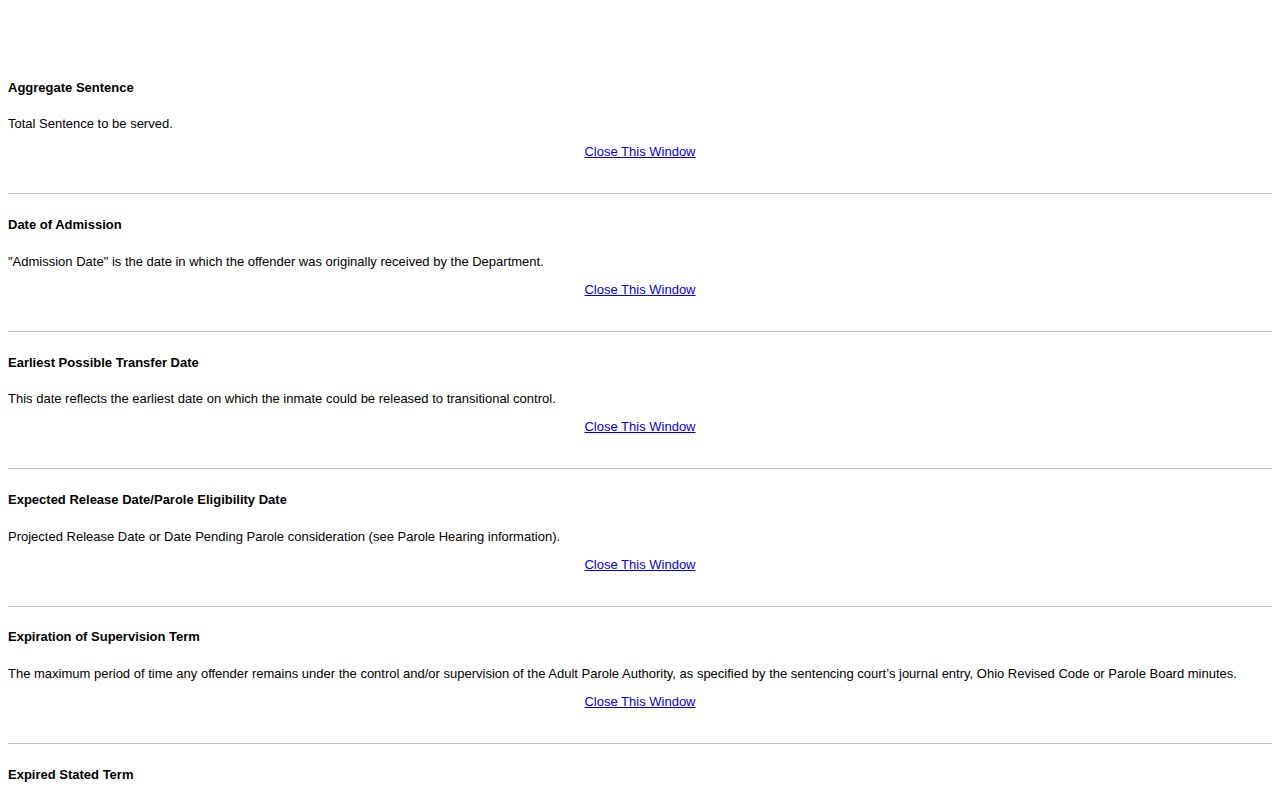
Those definitions show why a future field should be treated as a projection or eligibility marker until a later release status confirms the custody change.
Defiance Prison Earned Release Credit
Ohio’s current earned-credit framework begins with ORC 2967.194, which applies beginning April 4, 2024, with transition rules. Earlier calculations can still involve ORC 2967.193. An eligible person can provisionally earn one or five days for each completed month of qualifying education, vocational work, prison industry, treatment, or other constructive programming. A second completed activity can add credit when the statutory terms are met.
Credit is not automatic. ODRC may deny or withdraw provisional credit after rule violations, and administrative review makes it final. Listed program completions can produce 90 days or 10 percent of the stated term, whichever is less. The ordinary participation and completion aggregate in the statute is capped at 15 percent of the stated term. The law excludes several categories, including mandatory or non-reducible terms, murder, aggravated murder, death, life without parole, and specified offense classes.
The common claim that everyone serves exactly 85 percent is wrong. That figure is shorthand drawn from a 15 percent ceiling for some eligible credit. Mandatory time, excluded offenses, jail credit, parole-eligible life terms, indefinite terms, judicial release, and separate court action can produce a different result.
The official earned-credit statute is captured below at the source identified in the image manifest.
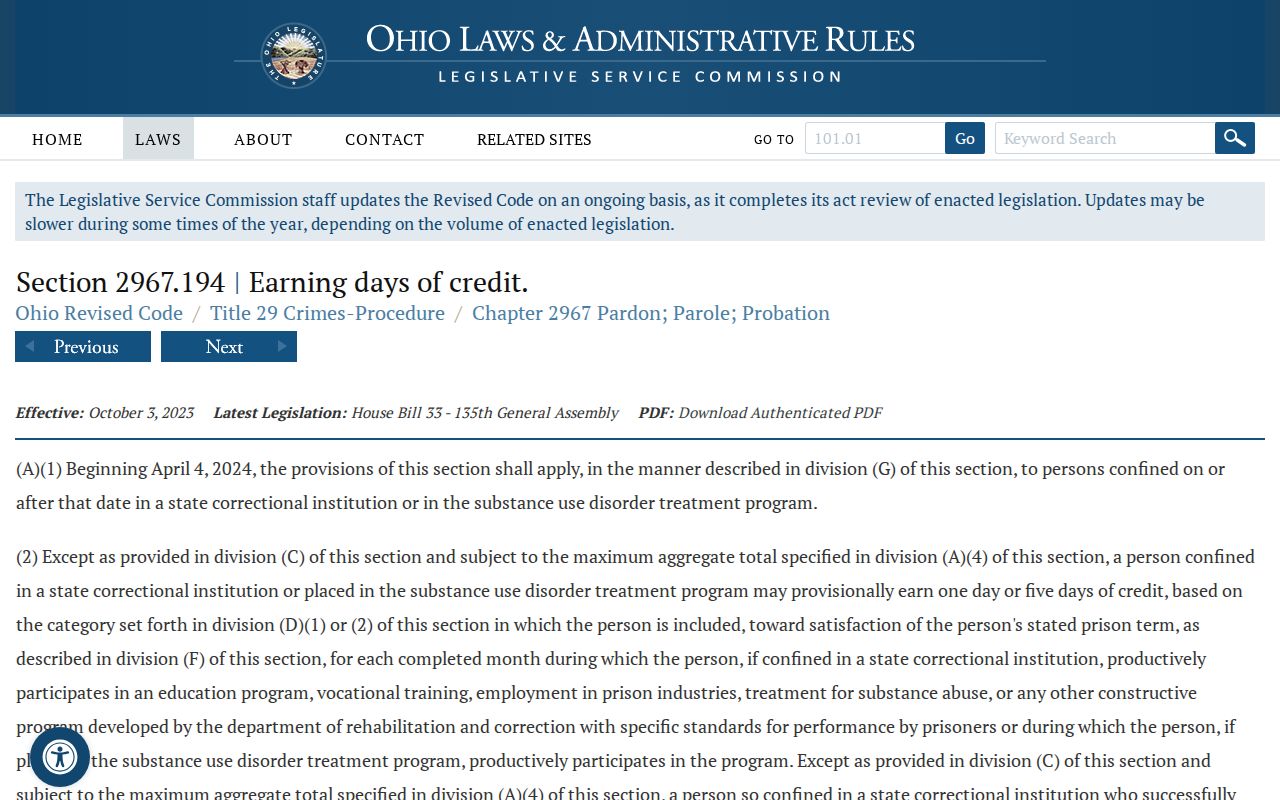
The statutory exclusions and caps demonstrate why a simple percentage calculator cannot replace the ODRC record and sentence documents.
Note: Jail Time Credit on an ODRC detail page is an input to sentence computation, not proof that a release event occurred.
Defiance Indefinite-Term Release Dates
Qualifying first- and second-degree felonies committed on or after March 22, 2019 can use a minimum-and-maximum structure under Ohio law. ORC 2967.271 presumes release at the minimum expiration or presumptive earned early-release date, whichever comes first. Yet ODRC can rebut that presumption at a hearing based on statutory misconduct or security findings and keep the person for an added reasonable period, up to the maximum.
A qualifying minimum also may be reduced by a Director recommendation and court approval for exceptional conduct or adjustment. The available reduction is not self-applied by the person reading the record. It depends on the formal process. That is why the minimum term, maximum term, expected date, and later ODRC decision must be read together.
The indefinite-term release statute shows the presumption and the circumstances that can support continued confinement.
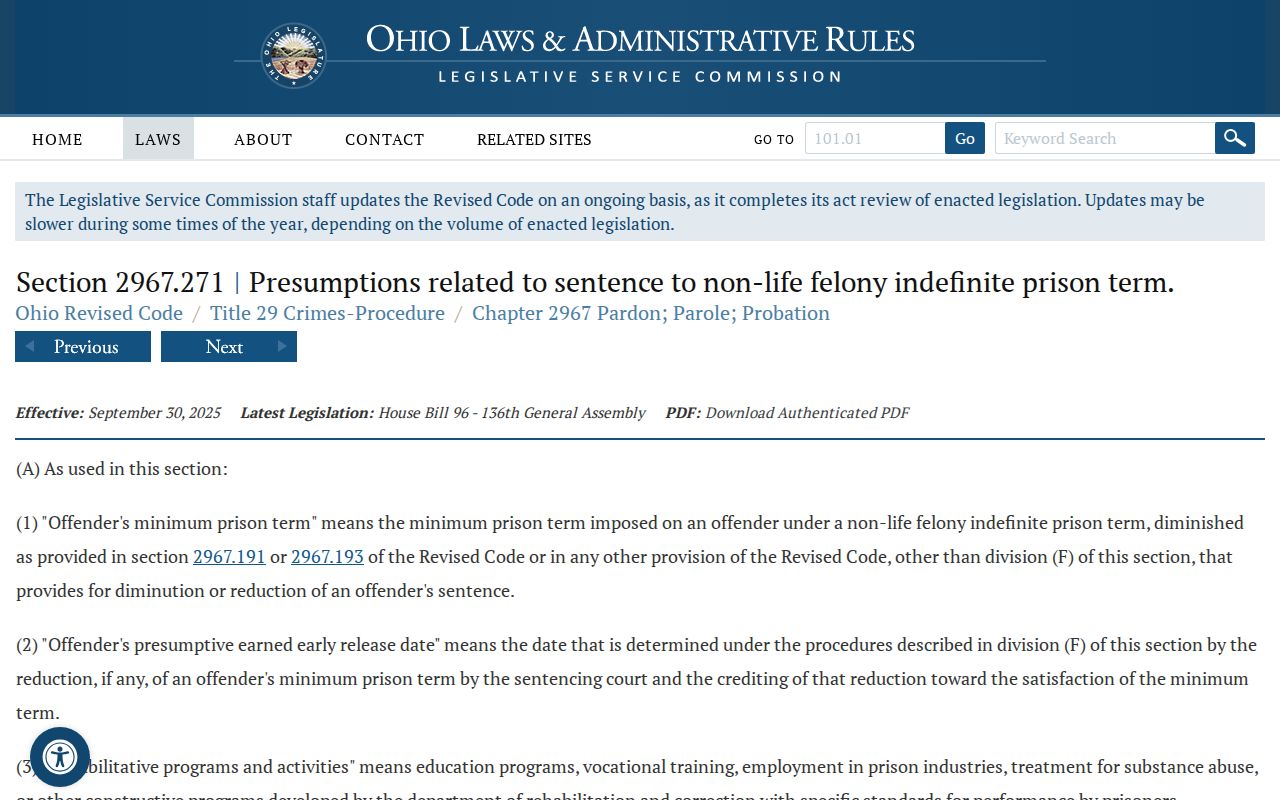
This framework explains how a once-plausible projected date can move without a clerical error in the public record.
What Changes Defiance Release Dates
A release forecast is built from records that can later change. Some changes shorten the term. Others postpone release or change the destination. The strongest explanation is an official court, ODRC, Parole Board, or jail record, not an unexplained date difference on a live screen.
| Factor | Possible effect | Record to check |
|---|---|---|
| Jail-time credit | Credits qualifying prior confinement against the prison term | Court journal entry and ODRC computation |
| Earned credit | May reduce an eligible term after qualifying work and review | ODRC computation under current statute |
| Discipline | Can cause provisional credit to be denied or withdrawn | ODRC decision and updated expected date |
| Court action | May correct credit, modify the sentence, or grant judicial release | Defiance court docket and journal entry |
| Parole Board action | Eligibility may lead to grant, denial, continuance, or a projected date | Hearing result, order, and public minutes |
| Other hold or transfer | May prevent community release or move the person to another custodian | Release/transfer record and receiving-agency confirmation |
An ODRC projected release date set in Parole Board minutes can be rescinded. Eligibility only opens a decision process; it does not guarantee a grant. For a county detainee, bond, dismissal, recognizance, and transfer are separate legal events rather than forms of earned credit.
Defiance Jail Work-Credit Approval
Ohio’s county-jail work reduction is distinct from state-prison earned credit. Under ORC 2947.151, a sheriff may allow a work-based reduction after considering the amount and quality of work. The possible maximum varies with the length of the jail term: up to three days per 30 days for a term of 90 days or less, up to four per 30 days for a term over 90 days through six months, and up to five per 30 days for a longer term.
The key Defiance release-date quirk is approval. A reduction takes effect only with written concurrence from the presiding or sentencing judge or magistrate. It is therefore unsafe to subtract the maximum from a CCNO term. Start with the sentence, apply documented jail-time credit and concurrent or consecutive structure, then apply only a reduction supported by the jail and written judicial concurrence. No Defiance or CCNO automatic good-time policy or weekend-release rule was found.
The county-jail reduction statute shows both the tiered limits and the written-concurrence requirement.
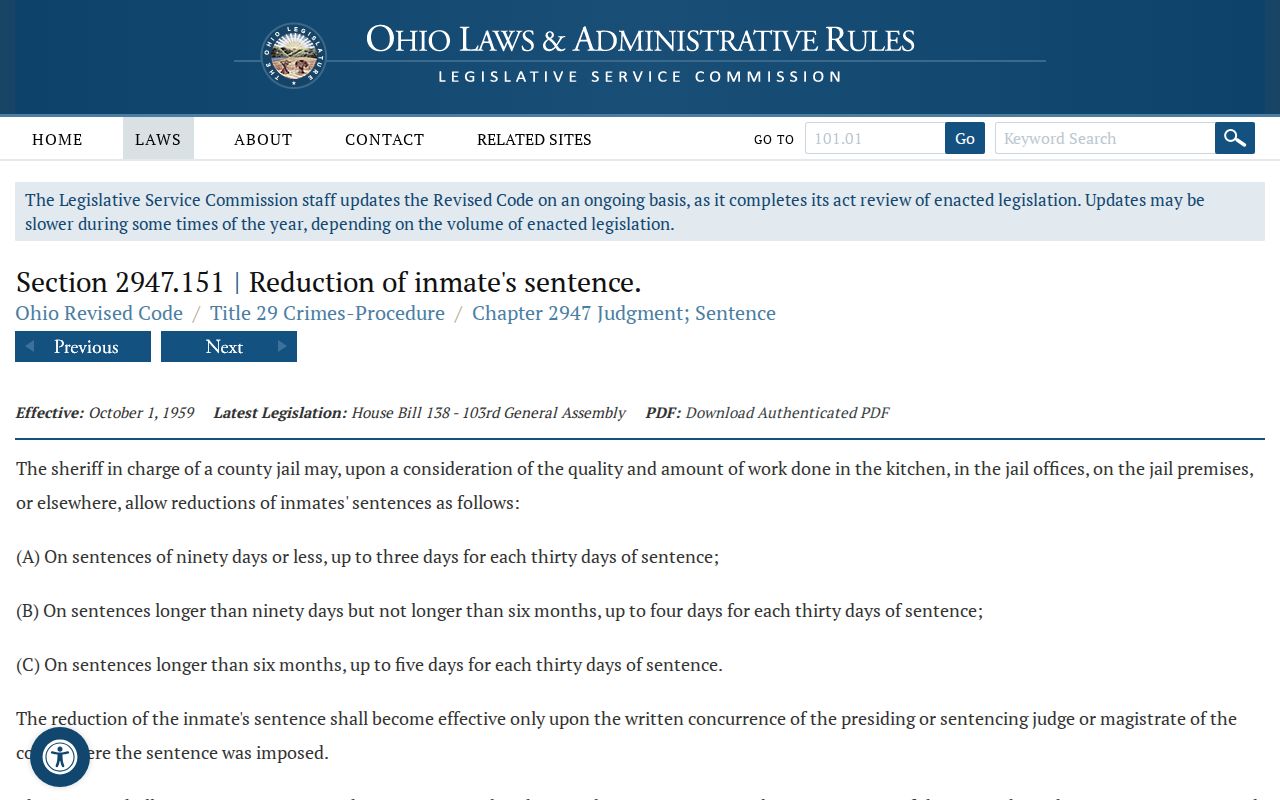
The required judicial approval is why an unofficial maximum-credit estimate cannot establish a Defiance County projected release date.
Defiance Parole Board Release-Date Decisions
Parole eligibility is another date that must be read as a decision point. ODRC’s Next Parole Board Hearing Date Search accepts a month in YYYYMM format. When the displayed month is in the future, the Board normally reviews the case about two months earlier so a decision can be ready. When it is in the past, the field represents the latest hearing month. Neither use turns the month into an exact release appointment.
Individual records can show the Next Parole Board Hearing or Review Month and the latest review type and result. Preserve the full result string. A transitional-control review, denial, recommendation, or recommendation pending a judge is not automatically a parole grant. Eligibility means the Board may consider release, and the later order or minutes state what it decided.
Under OAC 5120:1-1-10, the Board can establish a projected release date in its release-consideration process and place that decision in official minutes. The date can be rescinded. If the online summary lacks enough detail, request the public determination, order, or minutes under OAC 5120-9-49, then confirm the actual prison exit through ODRC status and supervision fields.
Confirm Defiance Actual Release Dates
For prison release, compare the ODRC status, Supervision Start Date, Parole or Release Detail, and court or board decision. For CCNO, request the closing record with the release date and time, reason, and any receiving authority. A court order supplies legal authority, while the jail transaction is stronger for the physical processing time.
Ohio VINE can provide a timely general-release or transfer alert while a matching record remains active. The Defiance VINELink check describes registration and event labels. A VINE alert is useful evidence of a reported change, but the durable jail, court, or ODRC record remains the better source for later verification.
If the online ODRC record has aged out after final discharge, write ODRC Central Records, P.O. Box 430, Columbus, OH 43216. Ask narrowly for the existing record of the date, cause, and terms of discharge and any public release decision. No researched fixed fee or turnaround applies to that request.